
A second sighting of a big cat has been reported in Frodsham, taking place just a couple of weeks after an animal was captured on CCTV sprinting across a paddock.
Daniel encountered the “very dark brown / grey” creature on Tarvin Road at around 9PM on Friday 9th April. He told Puma Watch: “About 100m in the distance I saw a large animal at least 4ft.
“I stopped to try and get more of a look through the bush clearing, but me stopping seemed to make it alert and it was so quickly aware, it very smoothly ran off back into the forest behind uphill.
“The run was very cat-like as I own a cat myself, but it covered about 50 meters in 5-10 seconds very efficiently without breaking a sweat.”
The CCTV above, recorded just a few weeks earlier on 18th March, went on to be featured in the Daily Mail, The Sun and The Daily Star. Chris, who reported the sighting to Puma Watch, told us: “We found a dead chicken late morning and then looking back at our CCTV saw a mysterious black animal on our paddock at around 6.20am.
“The chicken body was found on the path that this animal takes and there are a few footprints left behind too. It’s black and too big to be a house cat.”
The animal can be seen emerging from the top right of the video around 18 seconds in. A close-up then shows the animal again around 50 seconds in.
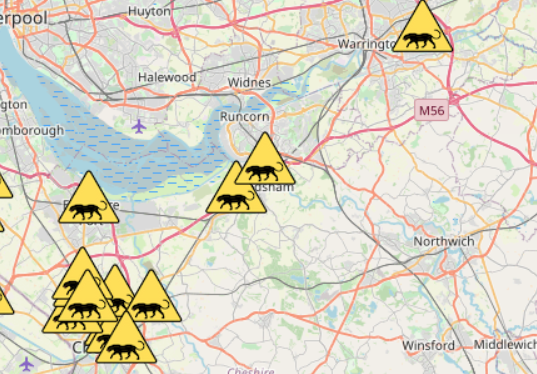
The sightings follow others nearby in Ellesmere Port, at Ince Marshes and Whitby Park.
Multiple sightings have also occurred in Chester in recent months, including when a similar animal was caught on camera in Chester Meadows and when one animal was spotted twice in the same night behind Asda.
Cheshire Police announced they were investigating whether “a larger predator” was responsible for a series of sheep killings, saying that “a large, black-cat type animal” had been spotted nearby.
Big cats such as pumas are solitary with a hunting range of dozens of miles. They’re mostly spotted in Snowdonia and the Clwydian hills but reports of sightings in urban locations some distance from these areas are becoming more frequent.

As seen with Llandundo’s now-famous goats, who have taken to roaming the town’s deserted streets during the coronavirus lockdowns, it’s likely that the reduced levels of human activity over the last year is encouraging big cats to roam further from the hills into more populated areas.
When big cats were banned as pets in the 1970s, it was legal to release them into the countryside to avoid expensive rehoming costs. Owners from across the UK travelled to areas like Wales to release their cats in the remote environment, where small but significant populations have thrived ever since.
Earlier this month, Bellingcat exposed an international exotic pet trafficking operation, in which Instagram celebrities posted videos with animals including monkeys, sloths and a range of big cats, including baby tigers, cheetahs, lions and pumas. The animals were sold to buyers around the world from a base in Dubai.
Also this month, a London man was fined after neighbours spotted he was keeping an African wildcat at his home. He purchased the animal from an unlicensed Russian company. The man had previously been reported to authorities but had told them he didn’t own the animal before eventually being caught red-handed.
It’s likely that many illegal owners in similar situations would release such animals into the British countryside. This prevalent underground trade, now fuelled by Instagram and social media, could be big a big part of explaining why so many big cat sightings are now being reported.